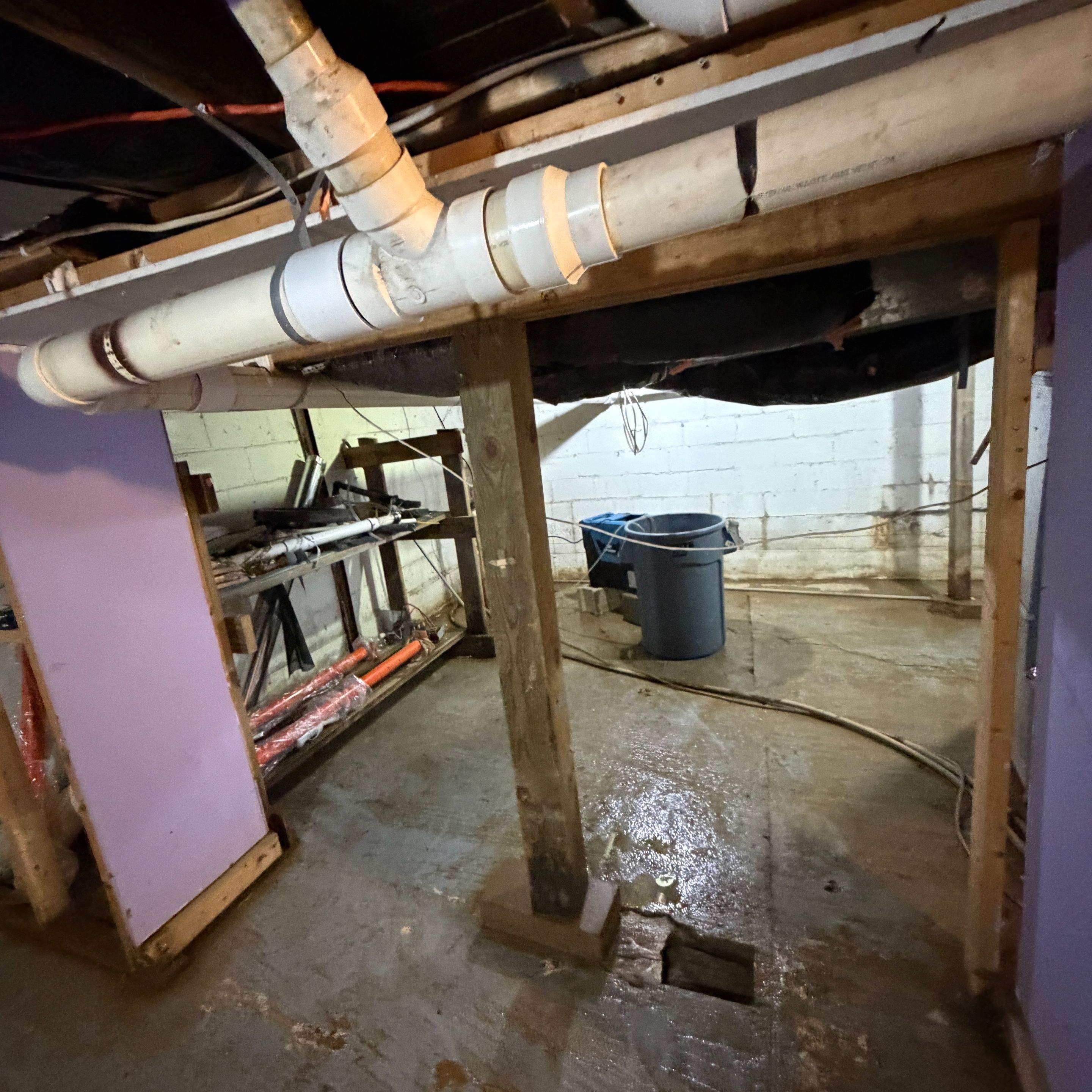
Before the Table: What Actually Determines Your Path
Three variables decide whether DIY cleanup is reasonable or reckless. The first is water category. IICRC defines Category 1 as clean water from a supply line or rainwater that has not touched contaminants. Category 2 is greywater, which includes washing machine discharge, dishwasher overflow, and rainwater that has picked up soil or chemicals on its way in. Category 3 is blackwater, meaning sewage, toilet backflow past the trap, or any flood water that has been sitting long enough to grow bacterial colonies. Category 1 can degrade to Category 2 in about 48 hours, and Category 2 can degrade to Category 3 in roughly 72 hours at typical Chapel Pines basement temperatures.
The second variable is volume and saturation depth. A quarter inch across a 200 square foot utility area is roughly 30 gallons of water, which a wet vacuum can pull in an afternoon. Two inches across a finished 800 square foot basement is closer to 1,000 gallons, and that water has already wicked up four to six inches into drywall and migrated under baseboards and tack strips. The third variable is what the water touched: bare concrete, sealed concrete, LVP, engineered wood, carpet pad, drywall, insulation, stored cardboard, electronics, or HVAC components. Each of these dries at a different rate, and some cannot be saved at all once saturated.
The First 60 Minutes Matter Most
Before you even decide between DIY and professional help, there is a sequence of actions that determines how much damage you are working with. Cut power to the basement at the breaker, even if the water looks shallow, because submerged outlets and extension cords are the leading cause of basement flooding injuries in Chapel Pines. Identify the source if you can do so safely. A failed sump pump, a burst supply line, a backed-up floor drain, and groundwater intrusion through a foundation crack all require different responses, and the Chapel Pines Water Restoration dispatcher will ask you which one you are dealing with. Move stored items off the floor in dry adjacent areas, photograph everything before you touch it, and pull any rugs or cardboard that are wicking water into walls. These three steps alone can save thousands in secondary damage.
The Core Comparison
The table below is the one we wish every Chapel Pines homeowner had in front of them at 11pm when the sump pump fails. Read it carefully before you commit to an approach.
| Factor | DIY Cleanup | Professional Restoration |
|---|---|---|
| Suitable Water Category | Category 1 only, caught within 24 hours | Category 1, 2, and 3, any timeframe |
| Typical Volume Handled | Under 1 inch in unfinished spaces | Any depth, finished or unfinished |
| Equipment Used | Shop vac, box fans, dehumidifier rental | Truck-mounted extractors, LGR dehumidifiers, axial air movers, moisture meters, thermal imaging |
| Drying Time to Industry Standard | 5 to 10 days, often incomplete | 3 to 5 days verified with moisture readings |
| Moisture Detection | Visual and touch only | Pin and pinless meters, hygrometers, infrared cameras |
| Antimicrobial Treatment | Household cleaners, limited efficacy | EPA-registered botanicals and biocides per IICRC S500 |
| Drywall and Insulation | Usually missed, becomes mold source | Flood cuts at 12 to 24 inches, insulation removed and replaced |
| Carpet and Pad | Pad rarely salvageable without extraction | Pad removed, carpet floated and dried or replaced |
| Out-of-Pocket Cost | $150 to $600 in rentals and supplies | $2,500 to $8,500 typical, often covered by insurance |
| Insurance Documentation | Homeowner photos only | Moisture logs, scope of work, line-item estimate matching Xactimate |
| Mold Risk at 30 Days | Moderate to high | Low when dried to 12 to 15 percent moisture content |
| Warranty on Work | None | Documented dry standard, IICRC backed |
| Time Investment | 20 to 40 hours of your labor | Crew handles extraction, drying, monitoring |
Reading the Table Honestly
Look at the cost row first, because that is where most homeowners stop. A $300 DIY cleanup looks dramatically cheaper than a $5,000 professional job, and sometimes it genuinely is the right call. If you have a Category 1 leak in an unfinished basement, caught early, with no porous materials affected, you can absolutely handle it yourself and we will tell you so. The trouble starts when homeowners apply DIY economics to Category 2 or Category 3 situations. The $300 you save up front becomes a $12,000 mold remediation project six weeks later, and your insurance carrier will likely deny the mold claim because you failed to mitigate properly under your policy's duty-to-mitigate clause. We cover that documentation trap in detail in our guide to filing a water damage insurance claim.
The drying time row matters almost as much. A shop vac and box fans can move surface water, but they cannot pull bound moisture out of drywall, framing, or concrete. Our low grain refrigerant dehumidifiers pull 12 to 30 gallons per day out of the air, which forces moisture out of porous materials and into the air where it can be removed. Without that equipment, your basement reaches a deceptive dryness on the surface while studs and bottom plates sit at 25 to 40 percent moisture content for weeks. That is exactly the condition mold needs. Concrete is especially deceptive because it can read dry to the touch while holding 4 to 6 percent moisture by weight, which is more than enough to feed mold growth on any organic material pressed against it.
The insurance row is where the math often flips entirely. Most Chapel Pines homeowner policies cover sudden and accidental water damage, and a properly documented professional basement flooding cleanup often costs the homeowner only a deductible. DIY cleanup leaves you with no professional scope, no moisture logs, and no leverage if mold appears later. Adjusters approve claims faster when they receive IICRC-aligned documentation, and they push back hard on homeowner estimates.
When to Call Chapel Pines Water Restoration
If the water is above one inch, has been sitting more than 24 hours, contacted any porous finish material, or came from a sewer or appliance discharge line, stop and call. The cost difference between mitigation started at hour 6 and mitigation started at hour 48 is often the difference between drying in place and rebuilding the lower 24 inches of every wall in the basement.